
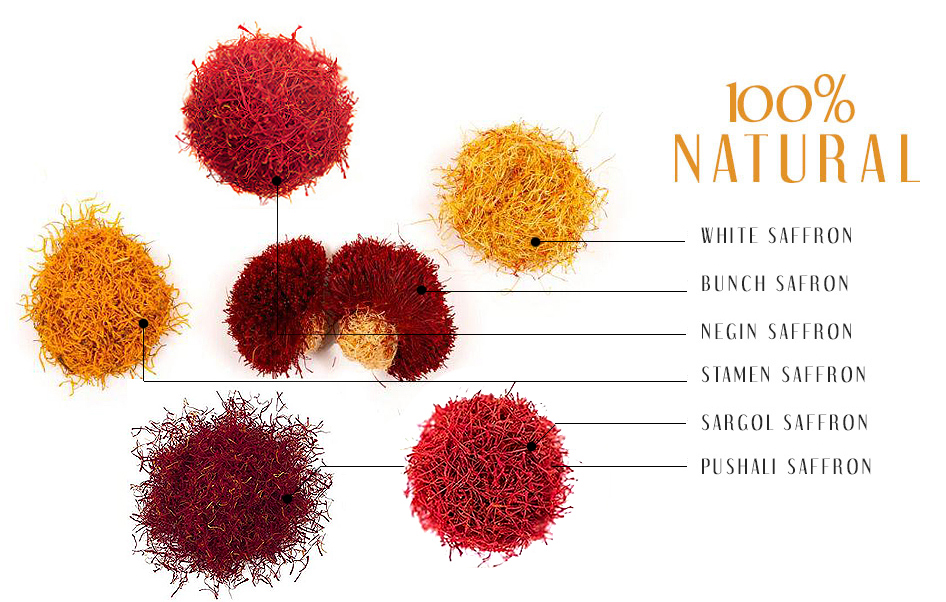

All grade of saffron:
-Super Negin (Highest quality)
-Negin
-Sargol (other name: All Red)
-Poushal (others names: poshal / Pouchal/ poushali/ Mancha)
-Dasteh (others names: Dokhtar pich/ Bunch/ Khooshe)
-Narmeh (other name: Powder)
-konj (others names: konge / Khameh/ root/ style )
Explanations about all grades:
Dasteh (others names: Dokhtar pich/ Bunch/ Khooshe)
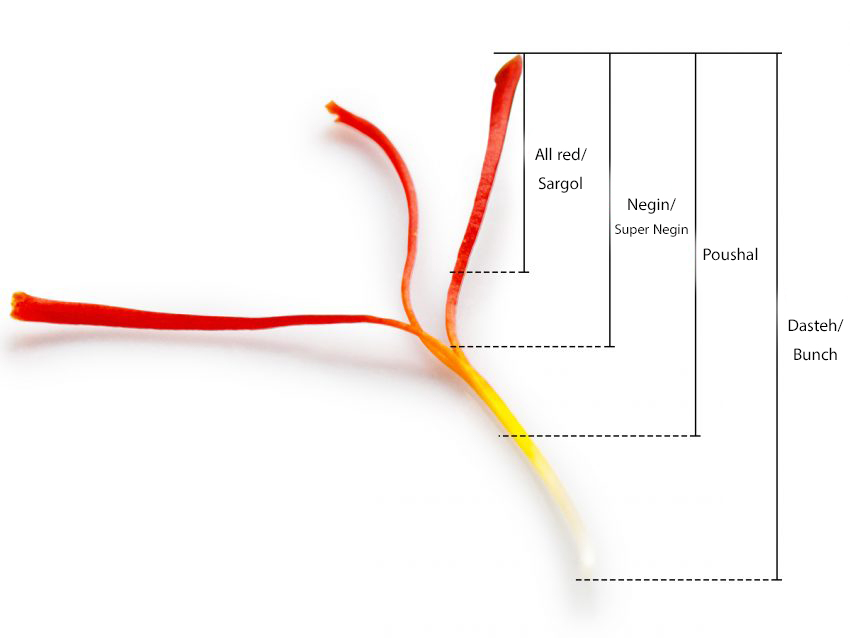
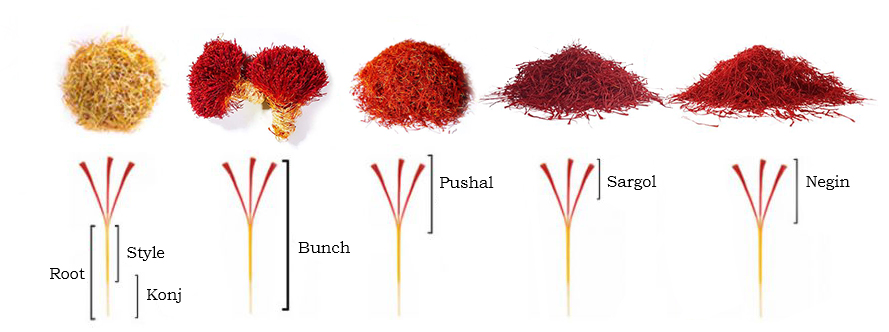
If we wrap many saffron threads from the khameh part with a thread or ribbon like a bouquet, we have made a saffron Dasteh. Dasteh saffron has both a red stigma and a white khameh. In other words, saffron is the complete strand of saffron, which has the red and yellow or white parts of saffron together. In such a way that the yellow part is about 30% and the red part is about 70%. In this type of classification, the saffron is intact and the stigmas of the three saffron branches are not separated from the white part of the saffron (or the saffron khameh).
Dasteh is the most basic type of saffron. The khameh part is usually 3 to 5 mm, and depending on the quality of the saffron, the stigma part can be shorter or longer than that. This feature is more related to decide of the person who cleans the saffron.
This saffron is also called Dokhtarpich, because usually women pick and sort this type of saffron by hand.
The saffron strands are placed on top of each other in two ways, one strain and two strains. In a one-way method, the stigmas are placed on one side and the khamehs on one side, while in the two-way method, the stigmas are placed around and the khamehs are placed in the middle. Usually, the two-way method is more attractive from the eyes of customers.
It is interesting to know that according to the quality of saffron flower, the amount of stigma and khameh can be different. For example, stigmas can be shorter than usual or less red in color.
Bunch saffron has a lot of curly and has less coloring power and fragrance than other types of saffron.
Specifications of Dasteh Saffron:
– It has a lot of curly (or wrinkles).
– It is usually in the form of pieces gathered together.
-this model of Saffron is completely coiled.
– The white part at the end of the thread is too much.
-It is at low level in coloring and fragrance.
-Due to the difficulty of work, this type of saffron is less produced today.
– This type of saffron has khame and stigma together, so it is practically impossible to cheat it.
– Because the drying of the khameh takes more time than the stigma, the stigma loses part of its color and aroma during the drying stage; Therefore, its quality is lower than other types of saffron grades.
– In bunch saffron, three branches of the stigma are not separated and are next to each other.
-Dokhtarpich saffron has a lower and more economical price than other types of saffron categories.
– The coloring power of bunch saffron is 120 to 150 units.
Poushal Saffron (others names: Mancha/ poshal / Pouchal/ poushali)
In Poushal saffron, the khameh (white part) is separated from under the flower, In this way, the stigmas will have 1-3 mm of khameh.
At the end of the stigmas of the three branches of saffron, some yellowness or whiteness can be seen. For this reason, this grades of saffron is called Poushal.
Poushal saffron that has thick and smooth stigmas, without wrinkles and has less khameh (root) is called Poshal Ghalamdar, and Poushal saffron that has normal and wrinkled stigmas with more khameh is called Poushal normal, which has a lower price and quality than Ghalmdar.
Some people prefer this type of saffron due to the fact that the stigma is attached to the khameh and reducing the possibility of fraud in saffron because the possibility of fraud is very low and it is easier to recognize the originality of saffron.
Specifications of Poushal Saffron:
– At the end of the saffron thread, a small amount of khameh (white part) can be seen and it is not all-red.
– It has a lower quality than Sargol saffron (due to the whiteness of the end of the thread) and better coloring than the bunch model.
– It is intertwined and wrinkled (curly).
– Most of the saffron bought from the farmer is like this. This model attracts more customers’ trust due to the combination of some khameh with stigma.
-The coloring power of Poushal saffron is 170 to 250 units.
Sargol saffron
The most widely used and common type of saffron in Iran is Sargol saffron, and Iranian consumers are more familiar with this type of saffron.
In Sargol saffron, which is a pure saffron, the khameh (or the white part of saffron) is completely removed and only the red part remains. That is why it is called all red.
This type of saffron has much more coloring and fragrance than other types of saffron.
This type of saffron is divided according to the thickness and size of the stigma into premium, rooti and sarghalam saffron types.
The difference in quality in this category of saffron has caused the price difference in this category, and you see Sargol saffron at different prices in the market, which is normal.
Specifications of Sargol Saffron:
– Sargol saffron is the most common type of saffron, and most customers in Iran know this type of saffron better, and it is also considered one of the best types of saffron.
– Its quality is slightly lower than Negin saffron due to broken stigmas.
– Its quality is better than bunch and poushal grades and it can be used for export.
– In this type of saffron, its stigmas are completely separate from each other.
– Its stigma is completely red and there is no trace of whiteness in it.
– Stigma filaments are thick
– The amount of crocin and safranal in this type of saffron is very high.
– The coloring power of Sargol saffron is 210 to 260 units.
– Very suitable for export and use in industrial and medical purposes, household use, and most importantly cooking.
Negin Saffron
The most expensive saffron in Iran is Negin saffron.
Negin saffron consists of stigmas without khameh and has a very large volume. Negin saffron, unlike bunch saffron, is not wrinkled (or curly). The production process of Negin saffron is costly and time-consuming and has a high price.
This model of saffron has wonderful coloring and appearance and is very fragrant. In this type of saffron, the stigma is smooth and unbroken (Unlike Sargol saffron, which has broken stigmas). threads in Negin saffron is completely red like Sargol saffron, but it has a better shape and appearance than Sargol saffron. This has caused Negin saffron to have a higher price than Sargol saffron. But people of Iran prefer to buy Sargol saffron, which has the same color and aroma as Negin saffron, but has a lower price. But foreign customers are more inclined to buy Negin saffron. Negin saffron itself is divided into several categories based on the quality of the stigmas, and the best and highest grade of Negin saffron is called Super Negin saffron.
Specifications of Negin Saffron:
– Its stigma is completely red and there is no trace of whiteness in it.
– It has the highest quality because it has no white part and the stigmas are smooth and without breaks.
-It has excellent coloring, eye-catching appearance and high fragrance. This type of saffron is more liked by foreign customers.
– It has the highest price between saffron grades.
– There is no crease (or curly) in it.
-The three branches of the stigma are separate.
– There are no stuck together pieces in it.
– The coloring power of this saffron is 230 to 270 units.
Super Negin saffron (the highest quality in the grade of Negin saffron)
This type of saffron placed in the category of Negin saffron, with the difference that its quality is very high.
stigma branches have been separated in Super Negin saffron.
One of the differences between Negin saffron and Super Negin saffron is that its stigmas are large.
Most of Iran’s exported saffron is of this type, and foreign customers like this type of saffron.
Due to the large stigmas of Super negin saffron, it has a special beauty compared to other saffrons.
In Arab and European countries, this type of saffron has many fans. This type of saffron is also called negin momtaz (or royal) saffron.
Among the appearance features of Super negin saffron, we can point out that its stigma is bright, straight and completely red. Out of the total saffron produced in Iran, only one-tenth of it is super negin.
This type of saffron should not be exposed to direct sunlight, because it reduces its coloring. And it is better to store super negin saffron in a dry and cool place.
The coloring power of Super Negin saffron is between 250 to 320 units.
Narmeh Saffron (or Powder saffron)
Another category of saffron is Narmeh. This type of saffron is like a powder and that is why it is also called saffron powder.
Narmeh saffron is created in several ways:
– When moving saffron or changing its location, some saffron is broken and powdered.
– During the categorizing and grading of saffron, some of it is crushed and it produces narmeh saffron.
-powder saffron is sometimes got from sargol saffron, which is separated by a sieve and sold.
– Most of the time, this type of saffron has a very cheap price and is mostly bought for the raw materials of factories and industries. Of course, sometimes some powdered saffrons have a high coloring quality, which certainly increases their price.
-powder saffron is usually used as a raw material in the preparation of cosmetics.
Konj Saffron (others names: White saffron/ Root/ Khameh/ style)
The end part of the saffron thread, which is white, is called the saffron root. This type of saffron is actually the same saffron Khameh that is separated from the stigma in the category of Sargol, Pushal, and Negin saffron. This part of saffron does not have the red color due to the lack of crocin, but it contains all the properties of saffron and due to its reasonable price, it is a good option for using the edible and therapeutic properties of saffron. In general, white saffron, which is also known as “Konj saffron”, is not included in the main category of saffron grades.
The general public believes that the root part of saffron has more fragrance, but scientific investigations and analyzes show that the red part of saffron has more valuable substances. One of these substances is crocin, which moves inside the saffron plant from the red stigma part to the white root part, and because the cream part of saffron has more moisture, it causes more aroma from the saffron root to be smelled. Saffron root does not contain crocin (responsible for saffron coloring), but it has the properties of red saffron.
Saffron root has wonderful properties, and the price of saffron root is lower than saffron itself, and you can use it to make tea or make different types of masks that do not need saffron coloring.
The best type of saffron root, which has a slightly better color, is Sargol saffron root. Because this type of root contains a small amount of saffron itself, its coloring is more than the root of Negin and Poushal saffron.
What is the best grade of saffron?
As a buyer or importer of saffron, to choose the best type of saffron, you must know its types and choose the saffron that has the most coloring and fragrance power.
As we said before, saffron that has more stigma will have more color. Super Negin, Negin, Sargol, Dasteh and Poushal saffrons have high coloring power, respectively. As the result, the best grade of saffron can be considered super Negin saffron.
Count on us
contact us for supplying all kinds of saffron grades.
HAVA foods group is ready to supply saffron for you with any grade that you want in the highest quality at competitive and reasonable prices.
We will send saffron to you, wherever you want in the world as soon as possible. And we try to get satisfy our customers with give good services.
Please don’t hesitate to ask us any questions about saffron.
King regards
HAVA Foods Commercial Group


4 responses to “grades of saffron”
Great information, I did realize there was such a difference In saffron
we are happy that could help you with this information.
Great information, I didn’t realize there was such a difference in saffron. Next time I looking for saffron I will use your instructions to buy
ok,
Great,
whenever you want we are at your service.